

Transforming museums with Digital Signage: 4 solutions for engagement and accessibility
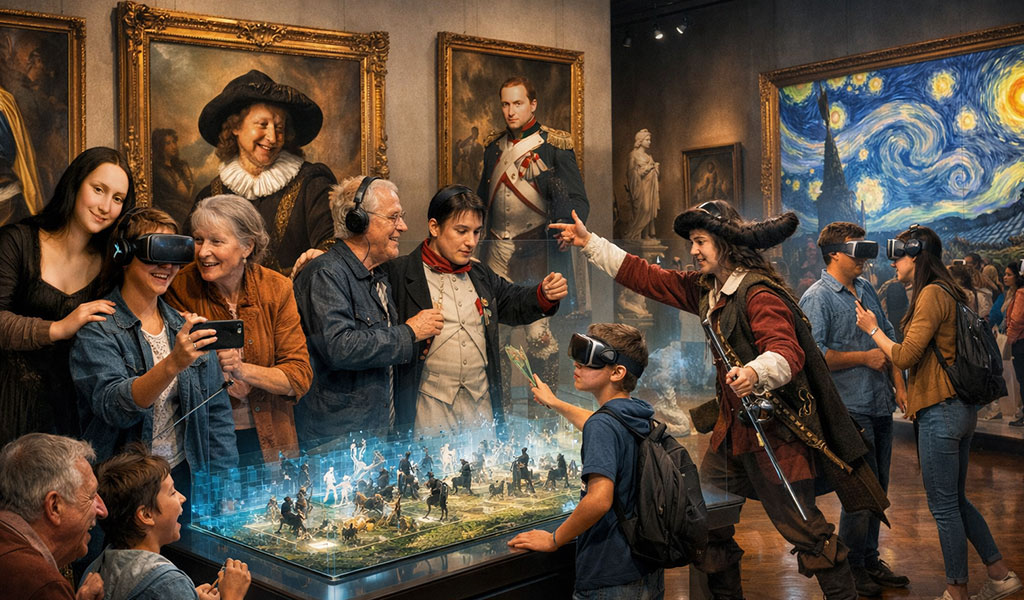
In the era of culture 4.0, the concept of the museum exhibition is undergoing a profound metamorphosis. Today’s visitors no longer settle for passive viewing; they demand an immersive, interactive, and personalized experience. In this landscape, integrating Digital Signage in museums and art galleries is no longer just a technological add-on—it’s a strategic necessity to connect with an increasingly demanding audience.
Over the years, the museum has progressively evolved. From a place of reverential silence for admiring paintings and sculptures, it has transformed into a dynamic space where visitors actively interact with the artwork.
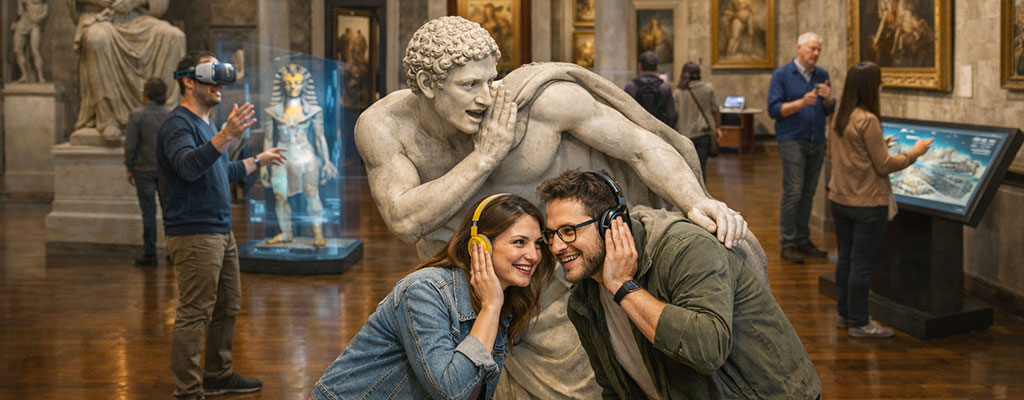
Endless walls of text and static labels have been replaced by interactive multimedia content. Audio guides, which once broadened accessibility compared to text alone, are now complemented by digital tools that make the museum truly inclusive for everyone.
Furthermore, this evolution has played a crucial role in bringing younger generations back to museums. Multimedia and interactivity have restored the museum’s appeal for children, teens, and young adults, allowing them to rediscover a cultural space that finally speaks their digital native language.
What are these tools? They are the various forms and integrations of Digital Signage: multimedia kiosks and professional displays integrated with AR (Augmented Reality), AI (Artificial Intelligence), and IoT (Internet of Things).
In this article, we’ll dive into the specific implementations that can transform a museum into an accessible, interactive, and highly engaging environment.
4 digital signage solutions for an accessible, interactive, and engaging museum
Embracing this digital evolution shouldn’t be a mere marketing stunt to simply “look good” in the eyes of visitors. The true objectives must be:
- Genuine accessibility: making content truly available to international tourists and individuals with any form of disability.
- Meaningful experiences: going beyond the “wow factor” to allow visitors to build their own personalized journey—screen by screen, content by content—focusing on what truly interests them.
It might sound utopian, but there are four practical solutions driven by Digital Signage that can move us in this exact direction. Let’s explore each one in detail.
- Dynamic storytelling
- Digital wayfinding
- Accessibility and inclusion
- Gamification
Let’s explore each one in detail.
1. Dynamic storytelling: overcoming the limits of traditional communication
A printed museum label, no matter how brief or detailed, rarely holds a casual visitor’s attention for more than ten seconds. “Walls of text” run the risk of being completely ignored, causing visitors to miss out on crucial information needed to fully appreciate the exhibit. Conversely, interactive digital kiosks and touchscreens not only encourage self-led exploration but also enable multi-layered storytelling. By giving visitors the power to choose which details to explore, they are more motivated to spend time and attention on each piece. How do you create dynamic storytelling in a museum wing?
- On-Demand deep dives: Visitors can choose to read an artist’s biography, watch restoration videos, or explore 3D models of the artwork.
- Multimedia integration: Combining audio, video, and high-resolution imagery transforms simple observation into a complete sensory journey.
2. Enhancing UX with digital wayfinding
Anyone who has visited a massive museum complex (like Louvre or Metropolitan) knows that orientation is a major pain point. Visitors often find themselves wandering aimlessly through halls, unsure if they’ve already seen an exhibit or not. Even the paper map handed out at the ticket counter rarely helps. Digital Signage solves this by deploying indoor multimedia kiosks at strategic intersections, acting as advanced “digital compasses.” Through interactive maps and digital directional signage, you can:
- Guide visitor flow: reduce bottlenecks in main galleries by suggesting alternative routes in real-time.
- Promote ancillary services: highlight the cafeteria, the museum shop, or ongoing educational workshops.
- Broadcast emergency alerts: In the event of an emergency, the entire screen network can instantly switch to coordinated safety and evacuation announcements.
3. Accessibility and inclusion: barrier-free culture
Museum accessibility is no longer a “nice-to-have” add-on; it is a mandatory practice for all cultural institutions, big or small. While Digital Signage can’t fix architectural barriers, the flexibility of the digital format shatters barriers related to content consumption. How? By following a few best practices.
- Instant multilingualism: leverage real-time content updates to offer instant translations. Exhibit details can be localized into dozens of languages with a simple tap on the screen.
- Visual impairment support: implement digital tools that allow users to enlarge text, adjust contrast, or activate text-to-speech (TTS) features completely autonomously.
- Auditory inclusion: display video content integrating Sign Language to make text and audio accessible to deaf individuals.
If you are interested in learning more about how to make your Digital Signage network accessible, read this article.
4. Gamification: engaging the next generation
As mentioned earlier, one of the primary challenges for the museum sector is winning back the hearts of younger generations. Gamification is one of the most powerful tools Digital Signage offers to achieve this. Touchscreen technology makes it possible to turn a museum visit and the learning process into an exciting game. Examples of museum gamification include:
- Quizzes and scavenger hunts: use displays to challenge younger visitors to find specific details hidden within the artworks.
- Augmented Reality (AR): integrate digital totems with AR solutions to show exactly how an archaeological artifact or ancient ruin looked in its original state.
If you would like to learn more about gamification, we discussed it in this article here.
If you’ve read this far, you’ll see that Digital Signage makes creating a more engaging, interactive, and accessible museum entirely possible—not through utopian ideals, but through precise, targeted best practices. Despite a significant initial investment, upgrading to multimedia kiosks and professional displays for museum communication ensures:
- Data-Driven optimization: the ability to track the real-world performance of on-screen content and optimize it on the fly, maximizing your overall ROI.
- Cost and time efficiency: the complete elimination of printing costs and a massive reduction in the time needed to deploy communications about new exhibits or events.
- Expanded audience reach: a renewed appeal to younger generations who will be incentivized to return, coupled with total, barrier-free content accessibility for users with visual, auditory, or motor impairments.